 Facebook
 Instagram
 YouTube
 TikTok
Crimes of the past – A guest blog post from Jim Kelly
As Jim Kelly is our Author of the Month for July, we asked him to write a blog post on writing crime fiction.
I am – apparently – an author of historical crime. I am not sure how this happened, or why, but I’m enjoying it a lot. The Eden Brooke series is set in the Second World War against a backdrop of air-raid shelters, tea urns, and dubious sausages (my mother said they were called ‘surprise bags’ throughout what came to be called The Duration) Given my fourteen previous crime novels were all contemporary, Brooke, my latest sleuth, is a startling change of direction. How did it happen?
But let’s look at that word ‘contemporary’. Many authors – myself included – write so called contemporary fiction which on closer examination turns out to be set in the past – often their own past. Napoleon said that to understand a man (and presumably a woman) you have to understand the world when they were twenty years old. This is the age at which personalities are formed. In many ways these are the years you spend the rest of your life inhabiting. This can show on the page. I suspect my original sleuth – journalist Philip Dryden – lives in a world not greatly dissimilar to 1977, the year I first got a job on a local paper. The first book came out in 2002. Looking at a first edition today I can’t find a single date – but the conceit was that it was ‘today – somewhere’.
The trick was the ‘somewhere’. Time isn’t the same everywhere. It might be 2002 in Piccadilly Circus, or Oxford Street, but in a small town in the Fens – Dryden’s world – it is often 1950 – let alone 1977. I was a student in Sheffield – a city I love. Walking in the centre that first day was like time-travel. It was 1950, or 1940, and in the industrial valley it was 1930. So setting the Dryden books out in the Fens was a neat marriage of my own psychological time and what we might call ‘local time’. I have since been out to an isolated village called Methwold Hythe – in the interests of Fen research – and it’s 1910 there, so who knows where this could end.
So Dryden’s world was within reach. Eden Brooke’s was a bigger challenge. I was born in 1957 – more than a decade after VE Day. But I did have another way back to the past. The war made my parents who they were. They lived through it in their twenties. My mum was in the London Blitz – with a child – while my dad was a Commando in North Africa, Italy, and Greece. The child was my older brother, and I grew up in a world where the war had just happened – a shadow over everything. So their world – of the 1940s – was mine at one remove, as it were. I picked up the rhythms of speech, the slang, the attitude, the feeling of being there while it happened.
So Eden Brooke’s world was not really that far away. I took the leap and set the books in the war. But there was one more powerful reason to switch to historical fiction. At the time I’d finished two series of crime novels both set ‘today’. I was keen to start a new story. I never thought of going back in history – which is odd because I love history; its often what I read, and it underlies everything I write. But the thought didn’t occur. I pretty much decided I would set a contemporary series in Norwich; a medieval city, with lots of atmosphere, isolated, near the coast, with a university. It seemed perfect. I even had a title: TOMBLAND, the Viking district near the cathedral.
But deep down I knew this was a bad call. I didn’t – don’t – have any real emotional connection with Norwich. The Fens, and the North Norfolk coast, really speak to me. In desperation I turned to Cambridge – just 17 miles down the road from my house. A city I’d always avoided in my writing, riddled, as it is, with cliches: punting students, vicars on bicycles, ‘dons’ sipping sherry, May Balls by the Cam, gruff porters in bowler hats.
The question was how to avoid the clichés? Which is when I thought of the past. Why not set it in the war – hardly any students, grey drab lightless streets, a town full of evacuees, soldiers – American soldiers –factories, chalk pits, juvenile crime. Not a tourist in sight. And so Eden Brooke was born. Not really an historical character at all – but an echo of my family’s past – still just within touch. Wonderfully, I now enjoy Cambridge much more, because I don’t see the aimless punts, the academic gowns, but I’ve always got my eye on the sky, in case I can catch sight of a barrage balloon.
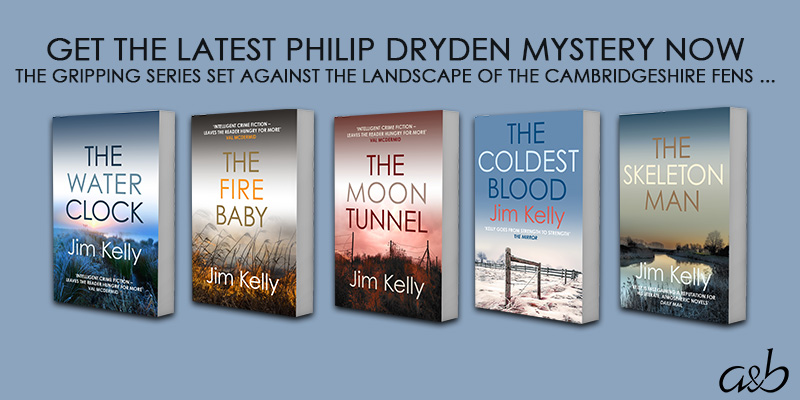
Click here to learn more about Jim Kelly or the Philip Dryden Mysteries.
Don’t forget to follow us on Instagram, Facebook, and Twitter to keep up with the latest news!